
The highlights of the RBI's fourth monetary policy review of fiscal year 2022-23 announced by Governor Shaktikanta Das.

Macroeconomic (macro) concerns, along with a cautious approach towards discretionary information technology (IT) spending, will see the revenue for Indian IT firms decelerate by 5 per cent through 2024-25 (FY25), from the highs of 12-18 per cent in 2022-23, said analysts from S&P Global Ratings. "The reason behind this slow growth is a macro slowdown. "Customers are cutting their discretionary IT spending, especially on projects that take longer to deliver quantifiable outcomes. "We also acknowledge that there are still strong economic headwinds for the next few years," said Spencer Ng, associate director, corporate ratings, S&P Global Ratings, over a call in a media briefing.
Economic Affairs Secretary Subhash Garg is the finance ministry's primary liaison with the RBI.

The reserves rose to $501.70 billion helped by a whopping rise in foreign currency assets, the latest data from the Reserve Bank of India.
At least a 25 basis points hike can be expected on the October 5 policy

Retail inflation dropped marginally to 7.01 per cent in June mainly due to slight easing in prices of vegetables and pulses, though it still remained above the Reserve Bank's comfort level for the sixth month in a row. The consumer price index (CPI) based inflation stood at 7.04 per cent in the preceding month of May and 6.26 per cent in June 2021. Inflation in the food basket in June 2022 was 7.75 per cent, compared to 7.97 per cent in the previous month, as per the National Statistical Office (NSO) data released on Tuesday.

Among other things, the agenda is likely to focus on increasing private investment, employment generation and giving relief to the farm sector

Dalal Street investors became richer by more than Rs 16.36 lakh crore this year as the equity market scaled new highs despite persistent geopolitical uncertainties and inflation worries. Analysts attributed better macroeconomic fundamentals, the confidence of retail investors and foreign investors investing again in the domestic equities towards the latter half of 2022 as the key factors that led to the outperformance of the Indian market in comparison to many other stock markets worldwide. During the initial part of the year, markets were jolted by the Russia-Ukraine war.

Reserve Bank Governor Shaktikanta Das on Wednesday said in the wake of appreciating US dollar, the movement of rupee has remained least disruptive as compared to its peers, and the size of foreign exchange reserve is comfortable. On a financial year basis (from April to October 2022), the rupee has appreciated by 3.2 per cent in real terms, even as several major currencies have depreciated, he said while announcing the latest set of bi-monthly monetary policy. "The story of the rupee has been one of India's resilience and stability," the Governor said while pointing out that the appreciation of the US dollar this year, which precipitated large-scale depreciation of all major global currencies including the Indian rupee, has drawn wide attention.

Terming investment in infrastructure "quintessential" to boost growth, the Economic Survey on Friday said post unlocking of the economy, infra sectors are poised for growth and construction of roads is expected to return to the high pace attained before COVID-19. The infrastructure sector will be the key to overall economic growth and macroeconomic stability, the Survey said emphasising that the year after the crisis (2021-22) will require sustained and calibrated measures to facilitate the process of economic recovery and enable the economy to get back on its long-term growth trajectory. "Basic infrastructure facilities in the country provide the foundation of growth. In the absence of adequate infrastructure, the economy operates at a suboptimal level and remains distant from its potential and frontier growth trajectory.

India's economic image is not affected due to Adani Group's recent decision to pull out Rs 20,000 crore FPO (follow-on public offers) amid allegations of financial wrongdoings, Finance Minister Nirmala Sitharaman said on Saturday.

India has been ranked as the most attractive investment destination in the world for the next three years.

Governments that did not respect the central bank's independence would sooner or later incur the wrath of financial markets, ignite economic fire, and come to rue the day they undermined the regulatory institution, Deputy Governor Viral Acharya warned.

Reserve Bank Governor Raghuram Rajan on Thursday said the central bank will continue its focus on taming inflation, speeding up resolution of distressed projects and ensuring enough capital for banks through balance sheet clean-up.

'India has always been a bottom-up stock-picking market, and as growth recovers with higher liquidity, mid and small-caps always tend to outperform.'

Probably 35 bps. There could be even an encore in February 2023 to take the policy rate to 6.5% before the financial year ends, predicts Tamal Bandyopadhyay.

Bank credit offtake is expected to pick up following normalisation of economic activities aided by the government thrust on public expenditure in current fiscal year, a report said. According to the Care Edge report, the gross non-performing assets (GNPA) ratio hit a six-year low of 5.9 per cent in FY22 but remained above the pre-asset quality review of 2015-16. However, it said, India's NPA ratio is one of the highest among the comparable countries despite gradual decline.

'Rhetoric and chest-thumping are running high on India's recent growth record.'
'But will the giant waves developing elsewhere allow us to sail smoothly into fair winds?' asks Debashis Basu.

A lack of adequate disclosures raises the financing costs of corporate firms, especially sub-investment grade ones, and keeps the capital markets small, believes RBI deputy governor Viral Acharya.
Governments that do not respect central banks' independence will sooner or later incur the wrath of the financial markets, ignite economic fires, and come to rue the day they undermined an important regulatory institution; their wiser counterparts who invest in central bank independence will enjoy lower costs of borrowing, the love of international investors, and longer life spans, said Acharya, who will return to the New York University's Stern Business School in August.

Finding resources for a fiscal stimulus could be difficult and it could jeopardise macroeconomic stability, says CEA.

All-out efforts are needed to mitigate the adverse impact of the Covid-19 pandemic, and the RBI will use any instrument necessary to revive growth and preserve financial stability, according to the minutes of the central bank's policy meeting.

India's economy grew 6.1 per cent in the fourth quarter of 2022-23, pushing up the annual growth rate to 7.2 per cent, official data showed on Wednesday.

The speed at which he led the central bank in different areas -- ranging from internal reorganisation to inflation fighting, stabilising the currency, taking on rogue corporations, cleaning up bank balance sheets, and opening the sector -- makes one believe that Rajan knew he had only three years to do his job. A fascinating excerpt from Tamal Bandyopadhyay's MUST-READ Roller Coaster: An Affair with Banking.

While Manmohan Singh had to deal with high oil prices, inflation and trade deficit, Narendra Modi is lucky as major threats have receded, says T N Ninan.

For the banking system a new cycle starts in FY2024. It's fraught with fresh challenges on asset quality and profitability, warns Tamal Bandyopadhyay.

While naysayers say the economy is on a downward spiral, optimists point out that India has experienced a shift of gears in the realm of policies, thanks to several initiatives of the Narendra Modi government, says Ashok K Lahiri.

The remarks came amid reports of mounting tension between the finance ministry and the RBI over the autonomy of monetary policy makers.
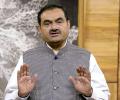
After a tumultuous past few days that almost halved value of the Adani group, embattled tycoon Gautam Adani-led conglomerate had some pressure eased on Friday as two global rating firms stuck with their calls on its credit profile and its French partner backed its investments in the group firms. Also for the first time since January 24, shares of the group's flagship firm Adani Enterprises ended in positive territory after erasing an intraday loss of 35 per cent. Adani Ports and SEZ also ended 8 per cent higher. This is after a over $100-billion rout in value of group stock since the US short seller Hindenburg Research accused Adani group of stock manipulation and accounting fraud.

If the rupee falls further, it would negatively impact the dollar-based returns of foreign investors, and could influence foreign flows into India.

Observing that there is liquidity overhand of Rs 13 lakh crore in the system, RBI Governor Shaktikanta Das said on Friday that the exceptional measures undertaken during pandemic will be dealt in sync with macroeconomic developments to preserve financial stability. Since the onset of the pandemic, the Reserve Bank has maintained ample surplus liquidity to support a speedy and durable economic recovery, he said while announcing the outcome of the Monetary Policy Committee (MPC) meeting. The level of surplus liquidity in the banking system increased further during September 2021, with absorption under fixed rate reverse repo, variable rate reverse repo (VRRR) of 14 days and fine-tuning operations under the liquidity adjustment facility (LAF) averaging Rs 9 lakh crore per day as against Rs 7 lakh crore during June to August 2021, he said.
The gross non-performing assets of banks may rise to 13.5 per cent by September 2021, from 7.5 per cent in September 2020, under the baseline scenario, according to Financial Stability Report (FSR) released by the Reserve Bank of India.

Over 15 years, with seven per cent growth, the Indian economy will be three times bigger.

Investments by private equity and venture capital funds (PE/VC) declined by 22 per cent in March to $4.6 billion spread across 107 deals, a report said on Wednesday. The deal activity showed an increase of 54 per cent by value at $15.5 billion across 360 deals, largely on the back of heightened activity in the startup space, the monthly report by IVCA and EY said. "While India's position as an attractive destination for PE/VC investments is expected to remain strong in 2022 given its high growth and macroeconomic and policy stability, the continuing geopolitical tensions, rising inflation, quantitative tightening by the US FED and inversion in the US yield curve are potential downside risks, making investors circumspect," Partner at EY Vivek Soni said.

From Covid to climate change, Shankar Acharya's look at some of the trends and events that might shape 2022.

In a tightening cycle, a premature pause in monetary policy action would be a costly policy error, Reserve Bank Governor Shaktikanta Das opined while voting along with five other members of the MPC for raising the key lending rate by 35 basis points earlier this month, according to the minutes of the meeting released on Wednesday. Prior to the December hike in repo rate, the RBI had raised the key short-term lending rate by 190 bps in four tranche.

'Investors should reduce cash gradually and look for value investing.'

Raghuram Rajan rejected the argument that inflation has come down largely because of "good luck" stemming from low oil prices.

The government is likely to introduce a bill on crypto currencies during the winter session of Parliament beginning November 29, amid concerns over such currencies being allegedly used for luring investors with misleading claims and for funding terror activities, sources said on Monday. Currently, there are no particular regulations or any ban on use of crypto currencies in the country. Against this backdrop, Prime Minister Narendra Modi, on Saturday, held a meeting on the crypto currencies with senior officials and indications are that strong regulatory steps could be taken to deal with the issue.

Prices of food items like cereals, pulses, and edible oils rose or remained steady in May, a Reserve Bank of India (RBI) report said, indicating there could be another higher inflation print. However, it observed that the Monetary Policy Committee's (MPC's) surprise move to increase interest rates bodes well for its credibility. The RBI's monthly State of the Economy report, released on Tuesday, citing high frequency food price data from the Ministry of Consumer Affairs for the period May 1-12, said the increase in the prices of cereals was primarily because of the surge in wheat prices.
